

Leading Through Uncertainty
A strategy field guide for navigating with clarity and conviction
So much is being asked of leaders today.
More than ever, leadership can feel like running through fog—able to see only a few steps ahead, reacting to whatever first appears through the mist.
This makes sense. We’re living through a period of great technological, social, and political transformation. And in times of great change, it’s normal to react with short-term thinking—to focus on what’s right in front of you, what can be fixed immediately, or what feels within your control.
But we need leaders who have a point of view on where they want to go long-term. We need leaders who can envision the broader terrain and bravely make choices about where to focus.
In this moment, we need leaders who understand what great strategy is, and are capable of building, leveraging, and adapting strategy.
That is what this field guide is designed to cultivate.
We created this guide to help leaders who feel stuck in the fog to lift their gaze, better understand what strategy is (and isn’t), when it’s needed, and how to lead teams in developing a clear point of view on where they are headed.
We hope to leave you with a sense of empowerment and optimism for what’s possible, particularly during times of change.
Ashleigh & Sarah

Ready to navigate with intention?
The Field Guide Essentials:

The struggle
Why strategy is a struggle for so many

the concept
A clear perspective on what strategy is—and isn’t

The signs
How to recognize you need a strategy

The practices
Six methods for enabling strong strategy


The Struggle
Familiar Word, Misunderstood Practice
There can be strategies for lots of different things: brands, businesses, organizations, teams, products, individuals… the possibilities are endless!
Endless possibilities makes for endless use of the word "strategy." It's often bolted onto the beginning of a title or process. Think: strategic actions, strategic planning, strategic priorities.
Yet the actual work of strategy is a relatively rare occurrence. And that's a good thing. An effective organization should spend the bulk of its time and resources bringing strategy to life, not building strategy.
But this means that most great leaders haven't had a lot of experience building strategy, yet they're pressured to be strategy experts.
So let's get clear on what strategy actually is.
Wherever there is a goal, there can be a strategy.

The Concept
Hypothesis at the Core
A strategy is a hypothesis regarding how you will leverage your unique strengths to achieve a desired outcome.
A strategy is an educated guess informed by research and knowledge.
HYpothesis
A strategy is built upon what you do particularly well that others cannot easily mimic or copy.
unique strengths
A strategy is informed by a clear understanding of where you want go and what you wish to achieve.
DESIRED OUTCOME
A strategy is not…
A goal. While goals, visions, or ambitions are needed in order to develop a strategy, they alone are not a strategy.
A plan. Plans are detailed roadmaps toward goals—these can be helpful in operationalizing a strategy, but a plan is not a strategy.
A framework. Frameworks can help capture and articulate ideas, but completing a framework does not equate to building a strategy.

The Signs
Hidden in Plain View
You might need a strategy if you notice…
External changes, such as new competition, shifts in customer behavior, or industry or regulatory changes
Internal changes, such as new leadership at the helm, a merger or acquisition, new growth ambitions, or emerging strengths or weak spots
Environmental Changes
Leaders struggling to make decisions or set priorities; this can be a sign that there is no clear compass guiding you forward
Teams expending lots of energy with little progress; this can be a sign that teams feel unmoored and uncertain about where to direct their efforts
Teams resistant to adopting new processes or systems; this can be a sign of attempts to address a strategic challenge with new ways of working
telltale behaviors

The practices
Moving into Clarity
Six practices for setting a strong strategy and taking agency over your future:
ONE
Start with Mindset
Mindset is the most frequently overlooked key to landing a strong strategy, and it will need to change throughout the journey.
The early stages of strategy development require an expansive mind that is open to possibilities. As the journey continues, it takes courageous commitment to choose a direction. Acting on a hypothesis requires reasonable openness to adaptation—maintaining awareness of how the world is shifting without allowing every shift to throw the strategy off-course.
Think about what you and your team bring to the process: Who excels at being curious and open-minded? Who brings analytical reasoning? The patience to explore? The bravery to make choices and take responsibility?

Be conscious of the mindset that you bring and how it influences your choices—and your team.
TWO
Lay the Groundwork
You've noticed the signs. You're aware of your mindset. Now it's time to act. Before you launch into exploration, your first action is to set foundations for success:
Frame the problem, getting clear on the root issue you seek to address.
Set clear goals that articulate what you seek to achieve.
Enroll support from your key stakeholders, and if you have resistance, be real about whether it will become a blocker down the road.
Confirm roles, ensuring team members are aligned on who will create the strategy, who will offer input, and who will hold decision-making responsibility (please, don't skip this one!).
Take the time to get clear and sturdy. Your future self will thank you.

three
Explore Your Landscape
Discovery, also known as landscape or terrain review, is the process of understanding the internal and external dynamics shaping your environment. The expansive mindset takes center stage as you explore forces and connect the dots between them.
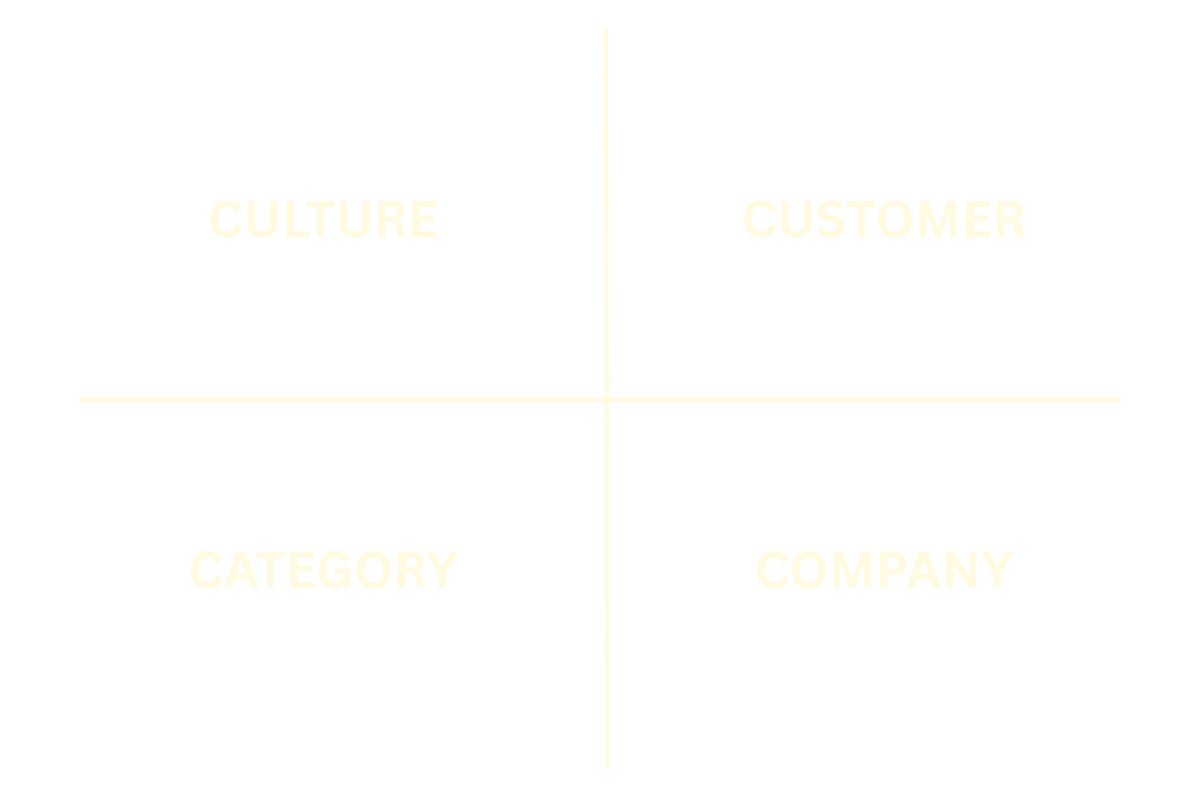
Adapted from the brand strategy world, the 4Cs Framework can be a helpful guide. By identifying distinct areas to research, it encourages exploration from multiple angles and ensures you don’t build a strategy based on knowledge about one or two areas alone (which, in our experience, is a common mistake).
Down the road, this work will provide the logic and confidence to support your eventual decision, so keep careful documentation.
Give yourself time to explore without an outcome in mind.
four
Consider, Then Commit
At this point, you may have an idea about the direction you want to take. It’s based on your landscape review, backed by insights, and you can imagine how it solves your problem and achieves your goals.
But before barreling forward, open your aperture. Identify multiple potential hypotheses and interrogate the benefits and risks of pursuing each of them before deciding on one.
One way to do this is in a work-session where team members identify and investigate 3-4 options together, exploring questions like: How might this meet our goals? What are the upsides? What comes off the table if we choose this path?
"Try on" multiple directions. Then courageously choose one.

Five
Remember, every strategy is a hypothesis. It's simply an informed guess.
The uncomfortable reality is that no one can predict the future with certainty. This means that your strategy will come to life in a world where the seas may shift, and your hypothesis will no longer be perfectly accurate or helpful.
So yes, you might get it wrong. You also might get it right. Your responsibility is to make a clear choice, knowing that it is better to work with an informed hypothesis than to be rudderless.
Give Permission To Be Wrong
Don't let uncertainty hold you back from moving forward.

Six
Test, Learn, and Adapt
If there's a chance you'll be wrong, what's the point of strategy? Think of your strategy as a compass, guiding you in a direction. It's not a map, instructing each turn along the way.
This is where an experimental mindset is helpful. There are some activities you know you need to do for maintenance. But other actions can start small and iterate as they grow. You can experiment with your methods along the journey and fine-tune your compass if needed. Determine what you want to learn, gather your knowledge, and then adapt as necessary.
This requires critical thinking, humility, and informed subjectivity, a.k.a. reasonable openness to adaptation. Don't throw your strategy out with the first sign of trouble, but don't get caught unaware of the shifts happening around you.
Treat actions as experiments that test your hypothesis.


In close: An Invitation
Strategy can feel overwhelming, especially amongst all the work going into maintaining the business of today. But with the right methods and mindsets it can be both fulfilling and enjoyable.
If you need a partner to work through it with you, please get in touch with us.